33 Best Recruiting Tools for Every Modern HR Leader

Navigating shifting candidate expectations, talent scarcity, and prolonged hiring cycles presents an ongoing challenge for talent acquisition leaders. As a result, many enterprise hiring teams miss their target recruitment goals because reliance on manual processes actively hinders growth. Therefore, adopting the best recruiting tools enables talent acquisition teams to eliminate administrative friction, centralize candidate data, and make data-driven hiring decisions.
Below is an curated overview of 33 top recruiting tools across eight core hiring categories, selected to help enterprise teams scale quality hiring.
The Core Pillars of a Modern Recruitment Stack
Before adopting new tools, every talent platform must align with five operational requirements:
- Workflow Automation: Automating administrative execution—including candidate outreach, interview coordination, and follow-ups.
- Unified Data Management: Storing candidate records within an Applicant Tracking System (ATS) or Candidate Relationship Management (CRM) platform.
- Advanced Analytics: Measuring critical recruitment metrics, such as time-to-fill, candidate funnel drop-off, and channel conversion.
- Ecosystem Integration: Connecting with core HRIS platforms, job portals, email suites, and calendar applications.
- Candidate Experience: Streamlining touchpoints via mobile access, fast communication, and self-service interview booking.
1. Best Recruiting Tools for Candidate Sourcing
Outbound sourcing tools enable talent acquisition teams to identify, map, and engage passive talent across global databases and technical networks.
- LinkedIn Recruiter: Offers deep database search filters and direct messaging capabilities to build active and passive candidate pipelines.
- Juicebox (PeopleGPT): Uses natural-language search models to discover, score, and engage specialized and technical candidates across multi-channel pools.
- SeekOut: An AI-backed talent intelligence platform offering skill-based sourcing, labor market analytics, and targeted diversity sourcing.
- hireEZ: An outbound sourcing solution that scans external public profiles, builds talent pipelines, and integrates directly with core ATS workflows.
2. Best Recruiting Tools for Applicant Tracking (ATS)
An ATS serves as the central operational backbone for managing applicant pipelines, interview scorecards, and hiring workflows.
- Greenhouse: A structured hiring platform designed to scale collaborative interviewing, scorecard evaluations, and pipeline analytics.
- Lever: Combines applicant tracking and candidate relationship management (CRM) to nurture passive pipelines and convert active applicants.
- Workable: An all-in-one hiring platform that pairs job distribution features with automated candidate recommendations and pipeline tracking.
- Bullhorn: Purpose-built for staffing firms and enterprise recruitment, unifying candidate management, client tracking, and operational communications.
- Jarvi: An AI-native ATS and CRM platform tailored for agencies, featuring automated candidate scoring, document generation, and client updates.
3. Screening, Skill Assessments & Behavioral Matching
Objective screening platforms evaluate technical competencies, cognitive abilities, and workplace behaviors prior to resume reviews to reduce bias.
- Canditech: Generates role-specific, practical skills tests from job descriptions, offering auto-scored coding, written, and scenario assessments.
- TestGorilla: Features an extensive library of skills, cognitive, and personality assessments to rank candidates objectively based on demonstrated capability.
- The Predictive Index Hire: Uses behavioral and cognitive assessment frameworks to help teams align candidate traits with specific role requirements.
- Harver: Offers predictive assessments, automated screening workflows, and matching analytics tailored for volume and enterprise hiring.
4. Interview Logistics, Video & Candidate Evaluation
Interview platforms remove scheduling friction and enable structured evaluation through automated coordination and recorded video formats.
- GoodTime: An enterprise scheduling engine that automates complex multi-stage interview loops, interviewer matching, and candidate rescheduling.
- Spark Hire: Supports asynchronous one-way video interviews, automated screening workflows, and video evaluation scoring across major ATS platforms.
- VidCruiter: Provides structured live and asynchronous video interviewing tools equipped with real-time scorecards and compliance logging.
- Willo: A lightweight video, audio, and text interview platform that enables candidates to submit responses on demand for early-stage screening.
5. Recruitment Automation & Conversational Engagement
Automation platforms streamline high-touch communications, application reviews, and routine candidate engagement across channels.
- Paradox: Uses conversational AI to automate candidate screening, answer FAQs, and schedule interviews via text, chat, and mobile platforms.
- Gem: An end-to-end recruitment platform combining sourcing, CRM capabilities, automated outreach campaigns, and pipeline analytics.
- Sense: An enterprise candidate engagement engine that automates multi-channel SMS and email touchpoints throughout the hiring cycle.
- Manatal: Combines candidate sourcing, automated resume parsing, and pipeline management features tailored for growing recruitment operations.
6. Social Media & Programmatic Recruitment
Social and programmatic advertising tools expand employer brand reach and direct targeted job ads to passive talent across digital channels.
- Joveo: A programmatic advertising engine that uses AI targeting to optimize job ad performance and spend across social, display, and search channels.
- CareerArc: Automates job distribution and employer brand messaging across major social media channels to increase application volume.
- Hootsuite: A centralized social management platform that allows talent marketing teams to schedule content, run recruitment campaigns, and monitor brand engagement.
7. Diversity Sourcing & Inclusive Hiring
Diversity recruitment tools help build representative pipelines by eliminating biased language and anonymizing early screening stages.
- Textio: Uses real-time language analysis to optimize job descriptions, cold outreach messages, and employer brand copy for inclusivity.
- Applied: Focuses on anonymized candidate screening, using work-sample questions and blind scoring to minimize unconscious bias.
- Vervoe: Evaluates candidates through role-specific work simulations and automated grading, allowing skills to drive initial shortlisting.
8. Recruitment Analytics & Reporting
Analytics platforms transform unstructured hiring data into actionable pipeline insights, helping teams locate bottlenecks and optimize source yields.
- Datapeople: Analyzes ATS records and job post performance to uncover funnel bottlenecks, source effectiveness, and compliance gaps.
- Metaview: Leverages automated call synthesis to extract key insights, structured data, and candidate sentiment directly from interview conversations.
- Google Looker Studio: A customizable data visualization platform that connects disparate HR spreadsheets, ATS feeds, and web analytics into executive dashboards.
9. Cost-Effective & Entry-Level Tools
For targeted searches or specialized setups requiring lightweight tooling, these platforms provide essential hiring functionality without complex deployments.
- Calendly: Simplifies 1-on-1 and panel interview scheduling by allowing candidates to select open calendar slots directly.
- Google Workspace: A flexible option for creating custom application forms, candidate tracking databases, and scorecards via Forms and Sheets.
- Breezy HR: A recruitment solution offering candidate management, job board distribution, and career site hosting.
A Strategic Framework for Selecting Your Hiring Stack
Selecting software requires an objective analysis of your hiring process bottlenecks and tech ecosystem. Evaluate options using these four strategic steps:
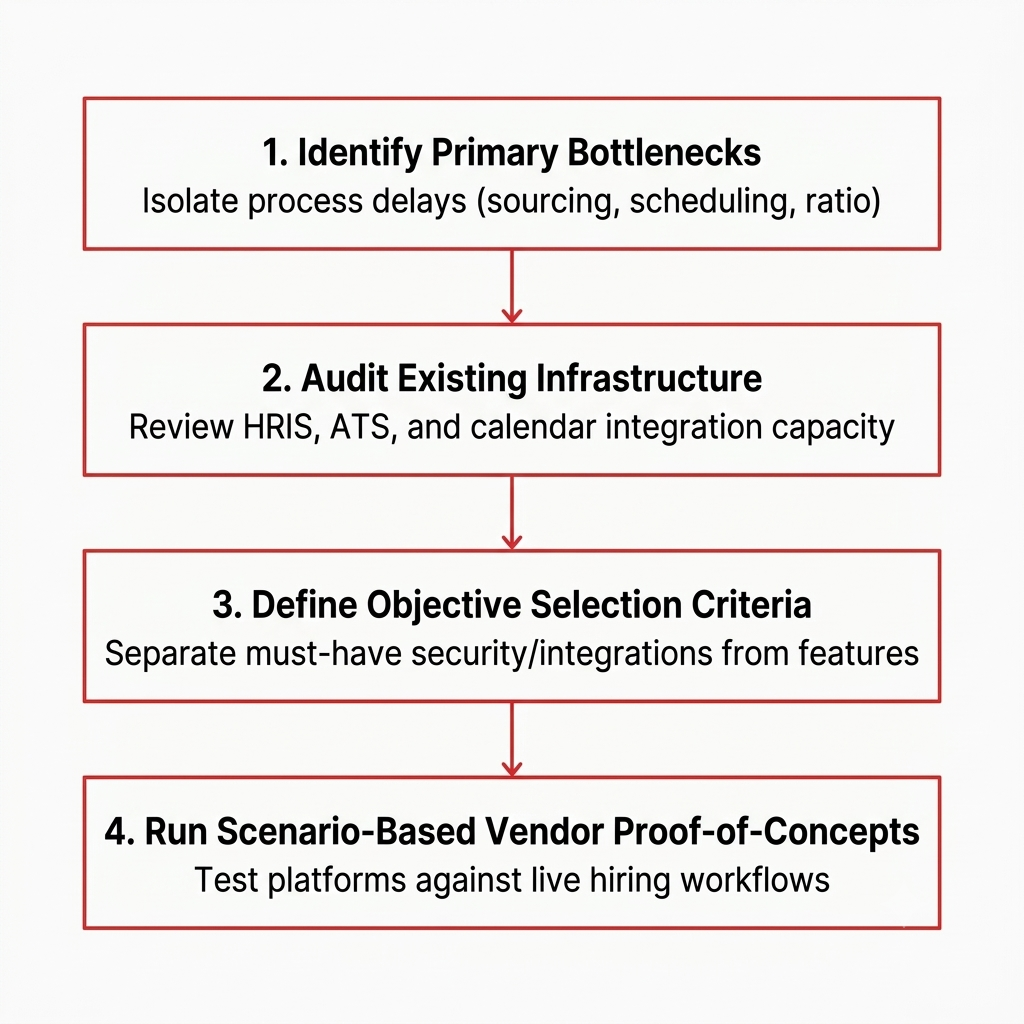
- Identify Primary Bottlenecks: Determine whether your recruitment delay stems from candidate volume, slow screening response times, or interview scheduling friction.
- Audit Existing Infrastructure: Map every existing HR tool to evaluate integration capabilities, usage rates, and redundant software spend.
- Define Objective Selection Criteria: Evaluate tools based on user experience, system security, data privacy compliance, and ATS integration flexibility.
- Run Scenario-Based Vendor Proof-of-Concepts: Test platforms using actual hiring scenarios rather than generic vendor sales demonstrations.
The FirstCall HR Perspective
While modern recruitment software streamlines candidate processing, technology alone cannot evaluate executive capability, cultural alignment, or leadership potential. Tools accelerate the funnel, but human expertise makes the final hire.
At FirstCall HR, we combine modern recruitment technology with deep executive search expertise. Through our signature low-submit, high-hit approach, we eliminate candidate noise, saving business leaders time while securing talent aligned with long-term business goals.
Transform your talent acquisition operations with strategic precision.